I find that the first months of the year can be a real roller coaster. You get to the end of the month, blink, and think, how is it done already? And then seconds later think, why did that month take so long? Time can be such a tricky thing. This past month has also had its ups and downs in weather here in Calgary. We went from winter to spring very quickly and had much less snow than we are used too. That just means that we will get so much snow later in the season (that is what typically happens!). It’s hard to plan for months like this because you never know what to wear! And of course the early months of the year always seem to come with colds and flus. I suspect it’s because we all stay indoors more often and the recovery from the busy holiday season. This leads to challenging days within the month. All of that can make your head spin!
I hope that this is something that most people can relate to. That months can seem long and short at the same time, that they can be unpredictable and frustrating, that you can have good and bad days, and that you can feel sick. This I believe is a good metaphor for the fluctuations of chronic illness and disability. Some days you feel fine, some good, some bad, some awful. Often you won’t know what each day will bring. You may wake up in the morning and know how you will feel, but other times it can change in the course of a day. This can make planning difficult and can also affect how you feel about yourself.
The start of the year can be a difficult time for many people and we can set for ourselves unrealistic expectations. If you are struggling with a goal that you set for yourself this year, know that that is okay! You can always change your goals or make new goals or give up goals. Change is not failure it is acknowledging that you and your situation changes every day. So when we start to beat up on ourselves, which we all do at some point, let’s take a moment, breathe, and say something kind to ourself. Tell yourself you are beautiful, that you are a good listener, that you make a great bowl of spaghetti, or anything else that you love about yourself. It can be difficult to start this practice, especially when you are in the midst of a bad day, so create a list of things you love about yourself on a good day and then when you do have a bad day you can take that list out and read it. If you are having a hard time believing what you wrote, say it to yourself out loud in front of a mirror. The more you do this the easier it becomes and the more you believe it. Trust me, it works, I have told myself the things I love about me many times and it has truly made a difference.
When challenging days and months happen it is so much easier to be hard on ourselves. Taking just a small moment and reminding ourselves that we are loved can make a difference. I hope for all of us that the next month is a little kinder and that instead of getting thrown about on the roller coaster we can laugh with joy throughout the ride.
Another year has come and gone. We are all another year older and hopefully a little wiser!
It is at this time of year that we come to reflect on the previous year and plan for the year ahead. It can be a time for negative thinking, but I wish that we can reframe our thinking and believe it is a time of strength and hope.
What do I mean by this? Well at the end of the year many people sit and recall everything they have done and sometimes it’s seems like we try to outdo each other in our accomplishments and how our year was awesome. But let me tell you a secret, no one is perfect and no one has a perfect year! We all struggle, we all have bad days, have bad things happen to us, didn’t do that thing we were hoping to do, and more. And you know what? That’s okay!
So instead if you take the time to reflect on the previous year let’s look at all of our strength. Firstly you get A+ marks in strength for making it through the year. Well done! Give yourself a high five, you deserve it. Now think about everything you have done; getting out of bed, eating, talking with friends and family, attending doctor’s appointments, and more things every day that some people take as “ordinary” but this year we are taking as strength! So give yourself another high five. If this was all you could manage this year then I’m proud of you for doing all that and for listening to your body. You can only do what your body lets you. But if you were able to do more let’s think about that now. Maybe you trained yourself to walk farther, or you can do more stairs, or you started that new hobby, or you went and did that thing you have been wanting to do. All these are strengths and successes you have accomplished! It’s very easy to remember the negative and challenges of the year—don’t worry we all do that—but let’s dig deep and create a list of the positives (even if that list is in your head!). End the year off with positive remembrance and you may be surprised at how much strength you have, how much you have done, and that you feel good remembering it all!
The next part of New Year’s reflection can be a tough one, thinking about the coming year. It’s so easy to be led by fear (ex. but what if it’s as bad or worse than this year?) or to create unrealistic expectations for ourselves (ex. think dieting and exercising resolutions). Now there is nothing wrong with either of these things, we all have fear and we all want to better ourselves. We can easily get sucked into societal trends and choosing resolutions or goals based on what we think people think of us rather than what we want to think about ourselves. So this year let’s really do some inner work and see what we truly need. We can lead the year off with hope, something that can counter the fear and be a reasonable outcome for the year. Let’s hope for more time with friends and family—even texting instead of meeting if that’s more reasonable—or wish for a beautiful spring day that you can spend outside looking at the flowers,
or being able to sit outside once a week and bask in the sun, or reading one more book than you did this year. By thinking about and wishing for things that you know you can achieve you can start the year off on a positive note.
I recently had someone tell me how they spend the last hours of this year and the first hours of the next year surrounded by friends and family in a large community setting with singing and contemplation. They said they like ending the year with community and beginning the New Year with positivity and togetherness. This is such a lovely sentiment. I know we can’t all follow this exactly, but what if we ended this year and started the next positively? Do something you love, speak to someone you love, speak to yourself with love!, and focus on the positives on the year we just had and think with hope on the positives yet to come.
You are stronger than you believe and joy can be found in even the darkest of places if we remember to look for it. I wish for you all a year filled with hope, love for yourself and love in your relationships, joy, and fun.
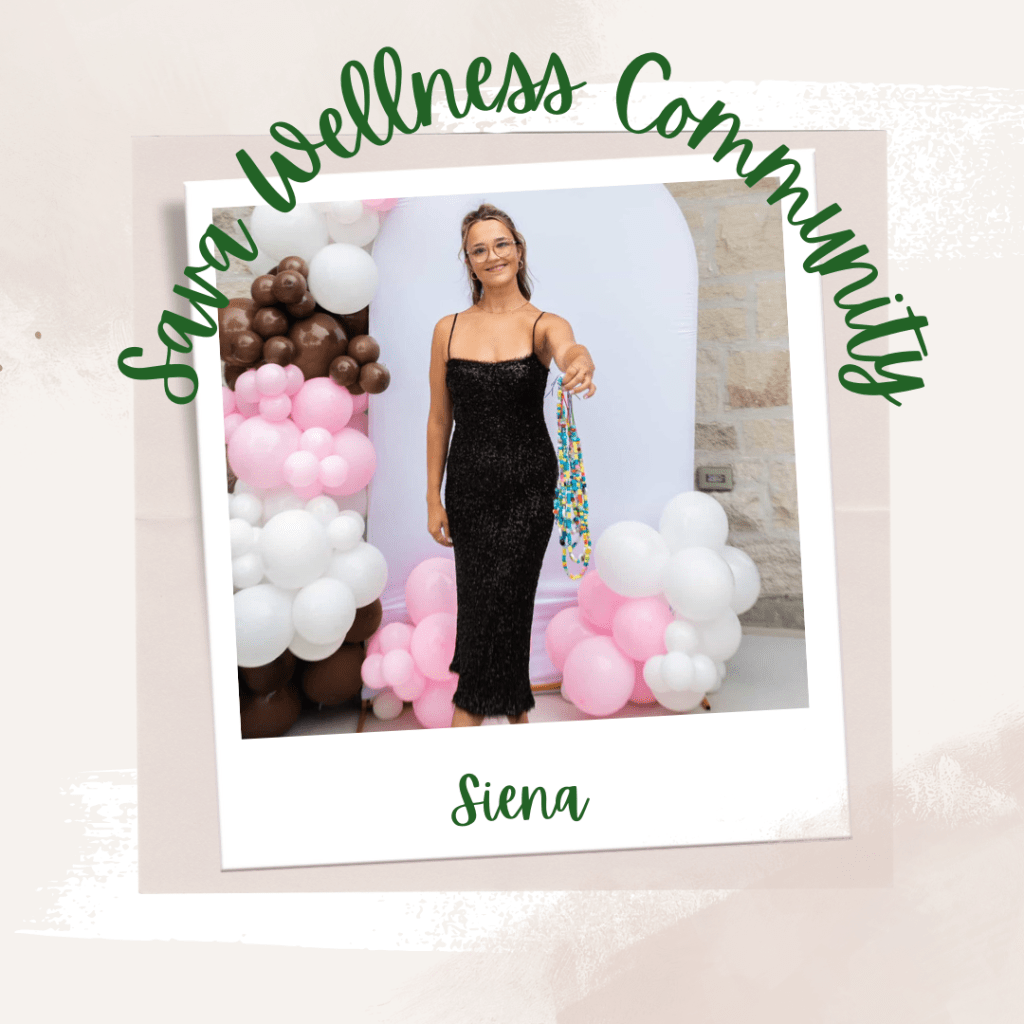
In this month’s interview we talk with Siena (she/her) from Toronto.
Hi Siena! It’s great to talk with you today! Can you please tell us a little about yourself?
Hello everyone, I am Siena (she/her)! I am 23 years old living in Toronto, Ontario. I am currently working on my masters in counselling psychology. I identify as someone who deals with chronic illnesses and have been since I was born premature with my twin sister; born 2 months early. Luckily my twin sister does not deal with health challenges but instead it came my way :)! I try to view my health as it has shaped me into the empathetic human that I am today. I have a bunny who is my everything, she makes me smile on my bad symptomatic days with her funny personality. I have found a hobby in reading, this year so far I have read 40 books. I have also fell in love with colouring. Both colouring and reading help clear my head away from both my health, school and just life.
Do you have a diagnosis for your symptoms?
In terms of diagnosis I have quite a few. When I was born the doctors found a hole in my heart. I had that closed at aged 5. I also had a hemangioma (a non-cancerous face tumour) grow on my face so I had to have 5 surgeries to remove that as I had cell regeneration which my surgeon has never seen in my given face location. I was also born with low muscle tone. I crawled instead of walked and started walking at age 3. I was equal speed crawling as my sister was walking! I got really confident in my crawling skills!!! After dealing with those things, everything calmed down until around my teenage years, when I was diagnosed with PCOS, scoliosis, hyperparathyroidism, kidney stones, ocular migraines, and IBS.
To me PCOS, which is polycystic ovarian syndrome, is a syndrome that is characterized by a hormonal disorder affecting everyone at different rates due to the large range of symptoms. For me it includes weight change, irregular or non-existent period, and high testosterone leading to increased body hair. It’s a disorder that I feel is very underestimated and under looked but affects so many beautiful people.
Additionally, I ended up also being born with a head tilt due to a nystagmus (constant eye shake), at the age of 17 I had my first eye surgery. It was a double eye surgery and the biggest surgery my eye surgeon has ever had to perform (he was a veteran surgeon!) and a surgery I wasn’t exactly prepared for. I ended up getting double vision from the surgery that was supposed to be temporary, but after weeks it was still there. I had another surgery to correct it but things visually were still not great. I ended up getting referred to a surgeon in Akron, Ohio, USA. I ended up having 3 more eye surgeries in the States with a total of 5 eye surgeries. They were very invasive and sort of traumatic which has now landed me with medical PTSD. While in the realm of mental health, I have also been diagnosed with anxiety, depression, and recently diagnosed with ADHD.
In terms of my eye surgery I had it because I grew up with a large head tilt. My normal 90 degrees was me looking almost up and I felt like a giraffe and we knew it may lead to potential neck problems down the road that seemed very daunting.
How long did it take for you to get a diagnosis?
Getting the diagnosis at 16 was yet just another diagnosis not realizing the impacts it would have on me as I started my early 20s with major weight gain and hormone fluctuations.
Which of your symptoms do you find the most debilitating and why?
My current symptoms that I am finding the most challenging would be my inability to workout leading to awful migraines and my body reacting so sensitively but also the constant fatigue – feeling like a zombie.
When did you first realize that you had chronic illness and how has your journey been since then?
While dealing with all of this I feel my health has always been a major part of my life. I try not to let it define me but on days it definitely does. With raging fatigue living what people call a regular life can definitely be very challenging. Additionally, having multiple appointments pretty much weekly feels like its own job that I don’t get paid for haha. I would do anything right now to work a job, but I also understand my health is my top priority and ensuring I am healthy for myself but also for my future clients as I start my psychotherapy career is essential. In the 23 years I have never struggled with health burnout until now. Those weekly appointments and daily symptoms of fatigue, feeling almost like a zombie, and migraine headaches that also come impacting my vision and productivity, those combine to make life a little more challenging. But I am embracing that I have a huge team behind me whether that be my family, my mum and dad, my sister, my large team of doctors, my friends, my boyfriend, as well as my health account on Instagram @sienashealthstory where I have found the most amazing people who also deal with health challenges who all motivate me, allow me to grieve those bad days, lift me up when needed, but also support me whenever I need it.
How has your experiences of the world changed since your symptoms started?
Since my health has been my whole life I don’t know much without it. But I take every day as it comes. I try to implement strategies to reduce burnout like journaling, colouring, reading, listening to music, petting my bunny, and enjoying the fresh air whenever I can.
What has been the most helpful for you as you have gone through this journey?
I wanted to create a health account for both myself but for others. I wanted to feel less alone in my journey – I love and appreciate my support system but it was also a challenge being the only one with health issues so there are definitely areas that people without CI [Chronic Illness] would not understand. I also wanted to share my journey in hopes of others not feeling alone. I am going into psychotherapy so I am going to slowly transition my health account that encompass me and my health journey while also integrating therapeutic ideas while not giving medical advice.
Is there anything you would like people to know about your chronic illness or chronic illness in general?
If you are in a similar situation or dealing with challenges relating to your physical or mental health, I see you and I hear you. I am always a message away. I love chatting about my health and looking on the positive side of things. Trust me I could go down a negative spiral but looking on the positive side helps me keep up the motivation to keep on moving forwards.
Thank you all for reading my story. If you have any questions or want to connect please don’t hesitate to reach out to me at @sienashealthstory on Instagram
Take care ❤
Siena McLaven
Thank you Siena! You can follow along with Siena on Instagram @sienashealthstory She is also an advocate for the St. Michael’s hospital in Toronto.
Being strong or feeling strong can feel like a tricky concept. Sometimes we believe that by saying we are strong we are arrogant. Sometimes we don’t feel strong at all but just like we are surviving which doesn’t feel like strength. Sometimes we compare ourselves to others and so believe they are strong but we are not. It is all these thoughts and more that make us question if we really are strong.
The answer quite simply is that you are strong. Each of us has our own hurdles and challenges that we encounter and overcome every day—from getting out of bed, grieving, relationship challenges, and so much more—we all struggle. Many days it can feel like we don’t succeed, but when we step back and really think about it, we do succeed. Every day we wake up and start anew. Each day we start with the challenges that haven’t been resolved or meet the new ones that happen and we keep going. If this isn’t strength, that we continue on everyday despite our circumstances, I don’t know what is. Having strength does not mean we have everything figured out, or that nothing will affect us anymore, it’s the fact that we keep going.
I have heard discourse about telling people with chronic illness/disability that they are strong can be insulting. That the person with the illness/disability didn’t choose to have these challenges and so they are just surviving, they did not choose strong. And while I see where this is coming from—usually out of frustration that we did not choose this—I believe that we can take this as a compliment. I wonder if many of us bristle at this comment because we don’t feel “worthy” of that comment since we “only” get out of bed every day or “don’t do anything”. I believe this is worthy became you are here, you are still here, and you make a difference in other people’s lives (need help with feeling worthy? Check out this blog post).
Strength doesn’t have to be loud: it doesn’t have to be lifting 400 pounds, completing a marathon, or any other incredible feats of physical strength. It can be quiet and soft. Holding a friend while they are crying; going to another doctor appointment you’re not sure will help but you’re hopeful; talking with a loved one even when you’re having a bad day and making them feel heard; walking from the couch to the kitchen when you are fatigued. These and so many more situations are examples of strength that happen in everyday life. Take a moment and think about the strength you have in you. Think about everything you have overcome. Think of everything you continue to do even with your limitations. That is strength.
Inner reflection on what we have been through can be hard, so you can start lightly and even just think about one situation in which you showed strength and take comfort in that. You are strong. Remember that.
In this month’s Sava Wellness Community Interview Series we talk with Ally from Arizona.
Hi Ally! It’s awesome to talk with you today! Can you please tell us a little about yourself?
I live in Arizona. I live at home still due to my chronic illnesses and disabilities, with my parents and younger brothers. We have two wonderful dogs.
My favorite hobbies are simple arts and crafts such as small diamond art projects, sticker by number, embroidery, coloring books, wood painting kits, and making bracelets. I also enjoy reading physical books and audiobooks, building botanical LEGO sets, and journaling.
The terms I like to use in relation to my illnesses/disabilities are: chronically ill, disabled, and person who is chronically ill. Additionally—autistic instead of person with autism (goes hand in hand with disabled). I used to describe myself as invisibly disabled in addition to the terms above; however, as my health has progressed, I am no longer invisibly disabled due to my medical devices.
I’m unable to work due to my chronic illnesses and disabilities. Being sick and disabled truly is a full-time job. For the past year, I’ve been on SSDI. SSDI is one of our forms of disability benefits in the United States. It’s a long process to obtain and typically requires “work credits,” meaning that you pay into the system. If you have a parent on SSDI, you can be granted it instead of SSI. It stands for Social Security Disability Insurance, while SSI is Supplemental Security Income.
Do you have a diagnosis for your symptoms?
My primary diagnosis is a primary mitochondrial myopathy with associated carnitine deficiency. It is considered to be a life threatening progressive neuromuscular disease that has the potential to affect every organ system. For me this means that currently my biggest related symptoms are muscle pain, muscle weakness and hypotonia, weakened respiratory muscles, a variety of severe GI issues, severe fatigue, and exercise intolerance. This diagnosis comes along with many comorbidities for me; my other chronic illness diagnoses are gastroparesis, intestinal dysmotility, asthma, chronic migraine, idiopathic bladder paralysis, orthostatic intolerance, and osteoarthritis. Outside of my physical health, I am autistic and have cortical visual impairment (CVI).
Does having a diagnosis help you?
It is very important for me that I have an overarching diagnosis because it gives context for my symptoms. Being that mitochondrial diseases are progressive by nature, it unfortunately makes sense when my health declines or when I am diagnosed with an additional condition. I have an internal validation knowing that there is a main cause for my symptoms. With many of my diagnoses, especially my mitochondrial disease and gastroparesis, I have been able to find supportive communities of those who understand what I have experienced.
How long did it take for you to get a diagnosis?
I was a newborn when I was diagnosed with a mitochondrial disease. The other diagnoses have come throughout my life at various times. Gastroparesis and intestinal dysmotility took the longest to be diagnosed. I began experiencing severe GI symptoms in late 2020, but was not officially diagnosed with gastroparesis until late 2023 and intestinal dysmotility until mid-2024.
If you don’t have a diagnosis, can you please describe your symptoms?
Despite having a diagnosis, I still have undiagnosed symptoms. These include joint subluxations, hyper mobility, unexplained easy bruising, recurrent infections, skin flushing, and skin reactions to almost every adhesive.
When did you first realize that you had chronic illness and how has your journey been since then?
I’ve been sick since birth; I feel like I’ve always known in some capacity. At the age of 15, my health quickly declined and this started the journey towards the diagnosis of gastroparesis, intestinal dysmotility, and orthostatic intolerance. Things have always been up and down with me health-wise.
How has your experiences of the world changed since your symptoms started?
Through the years, I’ve needed to rely on medical devices to stay alive. In 2022, I had surgery for a colostomy. In 2024, I had my first GJ feeding tube placed after years of drinking various supplements and formulas. Medical devices are scary, to say the least. They represent more than just attachments to my body—they come with trauma, grief for the body I once had, resilience, profound gratitude, and so so much more. My GJ tube and ostomy have taught me the value of my life, and that I’m worth fighting for. With my health progressing and my symptoms becoming more visible to others, I’ve forever had my experiences of the world changed. I’ve had to learn to NEVER take a good doctor for granted. They are hard to come by. The medical system has both broken me and built me. It’s taught me to advocate for myself and those around me, which is a skill I’m continuing to work on. Being sick teaches you about humanity. You learn the limits of other people’s empathy—who will stay, who will silently disappear, and who will come into your life in the most needed moments. You learn about the lack of accessibility in everyday life, and recognize those who fight for solutions and make space for everyone. The quiet kindness of bystanders; those who make you feel less alone in ER waiting rooms, hospital cafeterias, PT offices, and labs. You become more observant to stranger’s suffering, but also to their wins. My world view will never be the same, and my experiences are forever changing.
Which of your symptoms do you find the most debilitating and why?
The symptoms I find most debilitating are fatigue, muscle weakness, muscle pain, nausea, constipation, and abdominal pain. Fatigue is the worst for me. I sleep an average of 12 hours each night and spend an average 4 hours of resting in bed during the day. Muscle weakness significantly limits my mobility outside of my house as well as with exercise. I am an ambulatory wheelchair user, and usually cannot walk more than 1/4 mile. Over the past few years, I’ve had to rely on my wheelchair more often when outside of my house. Emotionally, this change has been hard. I am forever grateful for my wheelchair, that gives me independence and access, but still grieve for the mobility I once had. The muscle pain I experience contributes to my mobility as well. Muscle pain and abdominal pain for me are usually constant and uncontrolled. I’ve tried different interventions, but not yet found a treatment that works for me. Nausea is another daily struggle. I take nausea medication up to three times a day, but it doesn’t always help. Constipation from intestinal dysmotility often intensifies my abdominal pain and nausea.
Can you describe what a bad day symptom-wise looks like to you?
For me, a bad symptom day usually lands me in bed for the day. On these days, I’m unable to participate in the basic self-care activities such as brushing my hair or teeth. As “gross” as this may sound, that’s just my reality of chronic illness. Depending on how I’m feeling, I’ll do a different activity to adapt to my needs. This can be anything including watching TV or movies, listening to an audiobook, listening to music, doing sticker by number or color by number books, and puzzle books. On especially difficult days GI-symptom and fatigue-wise, I’ll rely 100% on my feeding tube for both nutrition and fluids. I also adjust the amounts of PRN [as needed] medications I’m taking to manage symptoms. If my body allows and if needed, I’ll take a nap; there are days where I’ll sleep for 24 hours.
When you have a good symptom day, what do you like to do?
Good symptom days are hard to come by for me. I do have days where my symptoms are less intense than normal. On the days when I am feeling especially good by standards, I try to cram any essential tasks that I can’t do on a regular basis. If I haven’t showered recently, that’s what I’ll prioritize. This unfortunately doesn’t happen as often as it should, but I keep clean in other ways. I’ll also try to put away any of my laundry and complete tasks on my to-do list. If my energy and pain levels allow after these tasks are completed, I’ll do something that brings me joy—starting a larger art project, reading a physical book, or baking.
What has been the most helpful for you as you have gone through this journey?
The most helpful thing for me as I’ve gone through this journey has been finding a community. For the past two years, I’ve been an ambassador for the Muscular Dystrophy Association. Once a week, I also attend a virtual music therapy group through the Melodic Caring Project. When you find a community, you no longer feel like you’re the only one with your experiences. You don’t have to explain the little things that the general public doesn’t understand.
Another very helpful thing for me has been the child life services at the hospital. Whenever I am in the ER, having a procedure, or admitted to the hospital, I request to see a child life specialist. Child life specialists are healthcare professionals that help support children and their families in a hospital setting by providing education, emotional support, and play. Typically, these services are only for children, however, I am autistic and benefit from them due to my support needs.
Thank you Ally!
You can follow along with Ally on Instagram @advocatingwithally
One of the hardest times for people with chronic illnesses and/or disabilities is the holiday season. In Canada, Thanksgiving is in October. Then Halloween—which can be hard for adults and children both when parties are involved. November brings American Thanksgiving and the start of Christmas parties. December is filled with holidays, Hanukkah, Kwanzaa, Christmas, and New Year’s Eve. While festive times can bring us joy and togetherness, it can bring a lot of stress for everyone and especially for those with chronic illness/disability. Families and expectations are enough for anyone but the added stress can really aggravate people’s symptoms and conditions. Another huge factor for people with chronic illness/disability is the fear/anxiety that once plans are made if they will actually be able to make it on that day or if they will have to cancel. No one wants to be the person that has to cancel the day of, but with changing symptoms sometimes that does happen. No one wants to cause disappointment or sadness for another person and so often even when symptoms are bad people will push themselves and go anyways even if they know they are either going to really pay for it the next day or not enjoy it as much as they would like. So what should we with chronic illness/disability do?
I don’t have the magic answer but here are some thoughts.
First, talk with the host far in advance about your desire to attend but there is a chance that you wouldn’t be able to make it on the day. Tell them this is no reflection on them. Say how you really want to attend but that your symptoms change day to day and you won’t know until the day of the event.
Second, if you can schedule a rest day on the day before the event so you can maximize you chance of attending! If possible spread events out to protect your energy and body.
Third, have structures in place to help you get to the event and enjoy it. Arrange in advance someone to pick you up and bring you home, comfortable clothing and maybe a cushion or pillow to sit on, food that you can eat and enjoy either to bring and heat up (which you made and froze earlier) or that the host has for you, and even a safe person at the event that you can talk to if your symptoms get worse and you have to leave early.
Finally, when you return home, have your resting and “emergency” supplies stocked—ice bags, heating pads, easy foods to open and eat, comfortable clothes to rest in, and activities to help you recharge. Be kind to your body.
It’s impossible in life to please everyone. So just be kind, to others and to yourself, and do the best you can. That’s enough.
Just A Girl Trying to Live in a Body that’s Super Moody
In this month’s interview we talk with Lisa from Arizona.
Hello Lisa! It is great to talk with you today. Could you please tell us a little about yourself?
My name is Lisa Goldstein I consider myself Chronically Ill and Invisibly Disabled.
I live in hot and sunny Scottsdale, AZ. I’ve lived in Arizona my entire 55 years.
I’m a proud mother of 4 grown ass children, 2 boys 2 girls, all healthy and thriving in their own way. I am also a Nana to 4 grandchildren. As an empty nester I have 2 fur seniors, a 14 year old Shih Tzu and a 8 year old Scottish Terrier, both females because girls rule!
I have a few things I enjoy doing, I guess I can consider them hobbies!? I enjoy cooking even though my diseases have tried to end that for me. I absolutely love to take long bike rides on my adult tricycle with my dogs in the back basket and because it’s electric I am able to go further than I use to. I absolutely love any type of live entertainment: concerts, plays, comedy shows, I try and attend as many as possible. I’m all about supporting the ARTS.
When I was able to work I started as a Social Worker and ended up as Certified Medical Assistant. I worked in family practice and cardiology.
Do you have a diagnosis for your symptoms?
It was always in me to help others. All that came to an end in 2015 when I started to identify with too many of the patients in the cardiology office I worked in. I first worked family practice and while working there I was becoming short of breath and stairs all of a sudden became my enemy. The doctor I was working for felt I was developing Asthma so he gave me an inhaler and that was the end of that. I started to develop new symptoms I couldn’t ignore, such as severe fatigue, swollen hands, and my short of breath was starting to affect my work. I decided to make an appointment with a cardiologist I trusted and underwent testing even though every test ordered came back unremarkable or “normal” I pushed for a cardiac MRI. That was the only imaging that showed a very rare congenital heart defect called Scimitar Syndrome or PAPVR. That was the first time I’d ever heard of the condition, let alone told I had it, and to think I had it since birth. A lot of my childhood and even adulthood struggles started to make sense. I was told I needed open heart surgery to repair my heart, this took a minute to accept but once I did finding a surgeon that was willing or trained to perform the surgery I needed was really hard. Most patients with the defect I had are babies and it is taken care of pretty quickly.
I was persistent and finally felt I found a surgeon that was willing and able to do the surgery.
Once the surgery was over within days I felt the same if not worse. I kept bringing it up to my cardiologist and pulmonologist and I was told it’s because I’m basically out of shape… even though I was back to needing supplemental oxygen to function. I knew it wasn’t because I was out of shape or over weight (which I wasn’t, I still pretty much weighed the same), I know out of shape people don’t need oxygen.
Luckily my insurance changed and after 6 months of basically feeling like death I was able to book an appointment with the Mayo Clinic Phoenix. My first appointment was set for 2 months out. After an evening at my youngest daughter’s High School graduation I knew I was dying at that point I made the decision to go to the ER department at Mayo. I was admitted into the hospital in severe heart failure. After 9 days of stabilizing my heart failure and tests it was discovered the previous surgeon basically didn’t know how to perform the surgery and I was left with the new pulmonary veins floating in my heart, hence the reason I couldn’t breathe properly.
The Mayo Clinic at the time did not have a surgeon on staff that could repair the problem so I had to be seen at the Phoenix Children’s hospital but when it was time for my 2nd open heart surgery it was performed at the Mayo Clinic. A year goes by and I began feeling like I couldn’t breathe again. I undergo tests and sure enough stenosis [narrowing] was closing my pulmonary vein. The surgeons first tried to use a balloon to reopen the vein, however it just collapsed so another open heart surgery was needed. This time I had to take a trip to Minnesota to the mother ship of the Mayo Clinic. So in December 2017 I flew to Rochester once again in severe heart failure. Once I landed I did not feel well so I ended up going to the ER, good thing I listened to my body because I needed a blood transfusion. Had I not went in, my surgery would have been postponed or cancelled, too much coordination and planning went into the trip so that was not an ideal outcome. About 6 days later after my 3rd open heart surgery I was flew back home, yep unbelievable!!
Three years into my recovery, cardiac rehabilitation, check ups, etc., I was still feeling short of breath but mostly with activity, and forget walking up stairs. I brought it to the attention of the cardiologist and he recommended some pulmonary function tests that I failed miserably. I was referred to a pulmonary cardiologist. After a right/left heart catheterization it was discovered in 2020 I had secondary pulmonary hypertension due to my heart’s inability to pump efficiently.
After getting on the correct medication I was able to breathe better. That goes without saying I do have Restrictive lung disease. I will always have difficulties breathing, it’s part of who I am. As an adult congenital heart patient I will need lifetime medical care, which was proven in August 2022 when stenosis was discovered in 1 of my 4 pulmonary veins that were placed in 2017. I’m now a member of the stent club!!
Fast forward and other weird symptoms developed such as fingers/toes changing color, difficulty swallowing, numerous gastrointestinal problems, the clincher however was the pain I was in. It started in my wrists and hands then my ankles and bottoms of my feet where I couldn’t walk, then bigger joints, knee, hip, lastly shoulder, I could not lift my arm to wash my hair, comb it etc. At that point I decided I needed to see my PC after countless doctors’ appointments, labs, and imagining, I was referred to Rheumatology (again, I seen one in 2021 which is a longer story), I was diagnosed with Positive Rheumatoid Arthritis and Systemic Sclerosis Sine’ Scleroderma (ssSSc) an extremely rare form of Scleroderma.
Which of your symptoms do you find the most debilitating and why?
Right now my hardest days are when I’m dealing with the autoimmune diseases. The amount of pain I’ve had to learn to function with is insane. I’m taking 3 medications, after some trial and error I think I’m on a regimen that will allow me to get back to some things I enjoyed like cooking, cleaning, biking, but the big one is leaving my house!!
Is there anything you would like people to know about your chronic illness or chronic illness in general?
Ten years into this health crisis, and I do mean crisis, it’s taught me to be:
Brave Patient Resilient Determined And have a loud voice!!
I’ve advocated for every single diagnosis because I just didn’t fit the description of what illness looks like. I was fairly young, in shape, and always smiling.
My advice for those dealing with any chronic illness/disease is keep talking about your symptoms till you find a physician that will listen and figure it out with you. Find a good support network. If there is not one in your area turn to internet platforms or hell create your own!
We all matter, our stories matter, and if I personally can help one person with my story I’m here for it. I’ve yet to connect with anyone who has Scimitar syndrome but I still have hope I will.
I share my experience with my illnesses on Instagram, just started on TikTok, but would love to expand. I don’t know where my voice will take me but I do know I enjoy expressing myself and how I live with my rare diseases.
Thank you Lisa! You can follow along with Lisa’s journey on Instagram @lisa.phights.chronicillness
No Matter the Functioning of Your Body, You are Worthy
In moments when we are feeling down, disrespected, or like a burden, it is hard to feel like you are enough let alone worthy. And these moments can stretch to full days, weeks, months, and then can become a state of being.
Ask yourself, do you feel worthy? Have you ever felt worthy? Is there a time where you can identify when you stopped feeling worthy?
It may be when you started having symptoms and/or your physicality changed from being “normal”. This is something that many people experience: that when their body and health changes so does their perspectives of themselves and their place in the world. As we work through the grief of a changed body and everything in life that goes along with it—as well as the mental anguish of fear, stress, anxiety, and a feeling of burdening those around us—we drop from ourselves the knowledge of being worthy. When looking at this list it makes sense why our sense of self changes! This is a lot to put on ourselves and we don’t often treat ourselves nice as we go through this—we beat ourselves up for not being able to do what we used to do or for what other people can do, and suddenly we have either dropped our estimation of our worthiness considerably or believe we are worthless.
Let me say something that is extremely important: we are all worthy. No matter who we are, what we can or cannot do, what we look like, what we feel, or what we think about ourselves, we are all worthy. Does this mean we are perfect? No but no one is and we are still all worthy! We are all growing every day and that is what is important, not perfection. And this growth—mentally, physically, emotionally, intellectually, relationally, spiritually—is what makes us human and all humans are worthy.
We would never call a friend or family member unworthy, that would be cruel. So why do we call ourselves unworthy? Self-compassion can help us here as we apply what we would say to others—the kindness and love that we would give to them when they are struggling—and apply it to ourselves. This is a first great step. The next step is starting to believe that we are worthy, recognizing that everyone is worthy and so are we. How to start? Fake it to you make it! Our brain loves repetition so repeat to yourself “I am worthy” three times in a row every day and see how your mindset towards this statement changes for the positive. And trust me this really works, I have tried this and the progress I have made is great.
If you feel uncomfortable to do this on your own or feel like something is blocking you, reach out to me and we can work on it together.
In September as nature changes it reminds us that change is natural and good. That we are allowed to change and that no matter how our appearance changes we are still who we are and we are worthy. Try saying “I am worthy” each day and see how the positive changes play out in your life. Enjoy the last bit of summer’s warmth and prepare for the coziness of fall.
In this month’s community interview we talk with invisible disability speaker and advocate Lauren.
Hello Lauren! It is awesome to talk with you today. Could you please tell us a little about yourself?
I live in Mississauga, Ontario. I live alone, but my immediate family are my parents and my brother who’s 3 years younger 🙂
I like to travel and try new restaurants with my boyfriend, hang out with friends in coffee shops, sing along to musical theatre songs, and dance. I also love watching dating reality shows haha.
I’m an invisible disability speaker on resilience and belonging. I speak to corporations, schools, and other organizations about my journey of going from never talking about the rare neuromuscular disability I was born with, to becoming a disability advocate, and how they can take the same steps I did to start embracing the parts of themselves they’re avoiding as well. I’m also an Ambassador for the Rick Hansen Foundation School Program, where I speak to K-12 students about disability and inclusion.
Do you have a diagnosis for your symptoms?
I do! I was born with Central Core Disease (CCD), a rare neuromuscular disorder where some of the mitochondria in my muscle cells are missing. You might have seen the meme, or remember from science class, that the mitochondria is the powerhouse of the cell; converting food into energy and energy into strength. Since some of my mitochondria are missing, I have about 33% of the physical strength of the average person, so things like walking up a flight of stairs, getting up from sitting on the ground, opening a heavy door, or carrying a lot of things are harder for me than the average person.
Does having a diagnosis help you?
Having a diagnosis really helped me, because I finally had something to Google to find out why my body was the way it was, and to look for other people who have the same diagnosis. Even though I was born with my disability, I wasn’t diagnosed until I was 21, and I didn’t hear the 33% strength confirmation until I was 26.
Not having a diagnosis for 20+ years was part of why I never liked to talk about my disability – I didn’t have the language for it or know what it was, to know how to or be able to talk about it. It still took me about 10 years from getting the diagnosis to speak about it publicly and be more open, but having a diagnosis definitely helped. When I was 26, I found a Facebook group of over 1,200 people who either also have CCD, or have kids who do, and it was really exciting to finally find a community of people who understand what it’s like to live my disability.
How long did it take for you to get a diagnosis?
I was misdiagnosed at 12 years old with a mitochondrial disorder, then finally diagnosed at 21 with Central Core Disease.
When did you first realize that you had a disability and how has your journey been since then?
I was born with my disability. When I was born I didn’t cry, couldn’t suck to be fed, and couldn’t move my limbs. I spent 2 months in neonatal intensive care and went into cardiac arrest, luckily while a doctor was right beside my incubator to save me. When I was 10 days old, I had my first muscle biopsy, but it was inconclusive.
I’m not actually sure when I first realized I had a disability – I always knew I wasn’t as strong as other kids and couldn’t do things like they could; like I couldn’t run, or jump very high, and I’d get tired more easily. But because I was undiagnosed for so long, I’m not sure when I actually connected it to having a disability, though it was likely sometime in elementary school.
When I was young, doctors didn’t think I’d live, and a lot of people thought I wouldn’t be able to go to a regular school or graduate university or work a job. I’m glad to have proved them wrong and done all of those things, it was just harder for me than the average person because I have less strength and stamina.
How has your experiences of the world changed since your symptoms started?
My symptoms have mostly been the same throughout my life – my muscles have always been weaker, and I’ve struggled with physical strength and stamina. I also need to fit in rest days/periods when I’ve been particularly busy.
Something that did change my experience of the world, even though my symptoms have been mostly stable, was finding out the 33% strength assessment of my muscles at 26. Up until then, I never really had a sense of how my strength compared to anyone else, so hearing the 33% measurement felt pretty dramatic. It was kind of a shock to hear that and realize I lived my whole life on 33% strength of the average person, and I worried about what kind of life you can have like that.
But then I realized, I live 100% of my life, and I’m happy with many of the things I’ve accomplished and the life I’ve built. I think it also gives me a greater sense of empathy, in that I realized I’ll never know what it’s like to live with 100% strength, so I don’t necessarily expect people to know what my life is like with 33% strength either. It makes me empathetic to the struggles that other people face, that you wouldn’t know from just looking at them.
Which of your symptoms do you find the most debilitating and why?
Getting tired more easily and having to rest more often can be frustrating – there’s a meme I see sometimes that’s like “I’m kind of like if a person who wanted to do a lot of things was trapped in the body of someone who needed to lie down a lot” and I felt that lol. Recently I went camping with my boyfriend and some friends at an arts festival that involved a lot of walking on uneven terrain in a field, and eventually my legs got so tired from all the walking that I wasn’t able to get myself up from sitting down anymore, and had to have my boyfriend or best friend lift me upright. It can be upsetting to face the things I’m not physically able to do like that, but I’m lucky to have great supports in the people around me.
What has been the most helpful for you as you have gone through this journey?
I live by a concept I created called the daily yay – which is part gratitude practice, and part mindset/perspective shift. Basically, it’s identifying and consciously appreciating something good every day. Maybe I saw a cute dog in my elevator, or tried a bakery I’ve been meaning to, or my boyfriend said something funny, or I hung out with friends; but I find putting energy towards recognizing something good that day keeps me going. Now as part of my invisible disability speaking, I’m spreading the daily yay as a means of building resilience through joy – whether you have a disability or not, positivity is a muscle that you have to work out regularly, and the daily yay can be a great start.
One of the hardest things to do is setting boundaries and learning how to say ‘no’. In this very connected world it can feel wrong to not always be in contact with other people, to not answer instantly to a message, to call someone back right away, or to even do every task on your list that day plus anything else that someone suggests or asks you to do. This is exhausting and a great way to push ourselves towards burn out. So how do we change our mindset to give ourself the time, and break, that we need and still feel connected?
I think the best advice I can give is a paraphrase from a book I recently read. One of the politest things you can do is only say ‘yes’ to things when you can give it your full attention and energy. Then when you do say yes the people in your life will know that it is an authentic yes, that you aren’t just there out of obligation or dreading it. It is polite to say no when you don’t want to do something.
Isn’t that crazy? That not only is it actually okay to say no, and healthy to say no, but it’s the polite thing to do! What a change in perspective and the more you think about it a relief. So this is a good starting point, knowing that it is okay to say no.
Why should we create boundaries? Because every one of us has a limited amount of resources and it’s kind to ourselves, as well as healthier, when we tend to stay within these limitations. And it is true that in order to help other people we need to fill ourselves up first. This means that taking care our ourselves is important—self-care is not selfish.
There are many kinds of boundaries you can establish: from reducing time on social media; only answering business inquiries during working hours; having an evening that is just ‘you-time’; reducing voluntary commitments to those that fill you up (if possible); having quiet alone time in your house if you live with other people; and so many more. Doing just one of these, or something along those lines, will already make a difference. Doing many could really change how you feel.
Now here’s the tough part—many of these boundaries involve decreasing time/energy/commitment with other people, and they may not like it that you have created these boundaries. Some people may try to push you back to where you were before you created these boundaries, stay strong. The more you enforce your boundaries, the more people will realize you are serious and respect that you have created them for yourself. If you need to, practice politely saying no to people to yourself in the mirror so that when it comes up in real life you know you can do it.
Another important thing to note is that when you create these boundaries you may find that people react to you in different ways. People are allowed to have feelings and their own reactions. That is totally natural. This doesn’t mean you have to change your mind about your boundaries. Make sure that when you explain your new boundaries that you are polite and respectfully tell them that you are doing what is best for you. Remember that everyone is responsible for their own feelings and their own reactions—you don’t have to feel bad, apologize, overly explain, or make it better for them, it’s not your responsibility.
On the flip side, people are allowed to have their own feelings but they are not allowed to be mean to you about setting these boundaries, they also need to respect you for taking this step. If they are really not nice to you about these new steps then it might be a good time to step back and think about this relationship and maybe even setting even stronger boundaries.
You are not a bad person for saying no and setting boundaries. You are honouring yourself and honouring the commitments you say yes to. At the start it may feel hard to say no and stick to what you have said, but it will get easier the more you do it.
It can be hard to start saying no right away so you can start by saying something along the lines of ‘I need to think about it first’ so then later you can either say yes or no once you had a chance to evaluate. There is nothing wrong with not answering instantly.
Learning something like this can be difficult to do on your own. If you have any questions or would like support on how to implement your own boundaries reach out to me through email.

![The words “Sava Wellness Community” are written in green cursive script over top of a polaroid picture. The polaroid picture is sitting on top of multiple layers of pink, cream, and white watercolour background. The polaroid picture has the name “Lisa” written in green under it. Lisa has her head resting on her right hand and is smiling at the camera. She is wearing a black t-shirt, denim overalls, and Donald Duck earrings.]](https://savawellness.ca/wp-content/uploads/2025/09/lisa-interview-september-2025.png?w=1024)
![The words “Sava Wellness Community” are written in green cursive script over top of a polaroid picture. The polaroid picture is sitting on top of multiple layers of pink, cream, and white watercolour background. The polaroid picture has the name “Lauren” written in green under it. Lauren is smiling at the camera and it pointing behind her to a light-up blue sign on the wall that says “good vibes”. Lauren is wearing glasses, has her long black and purple hair curled, and is wearing a black ¾ sleeve shirt and purple pants.]](https://savawellness.ca/wp-content/uploads/2025/08/0f73e3cc-2104-4864-bbf0-0f972c555ad4_1_105_c.jpeg?w=886)
 Sava Wellness