
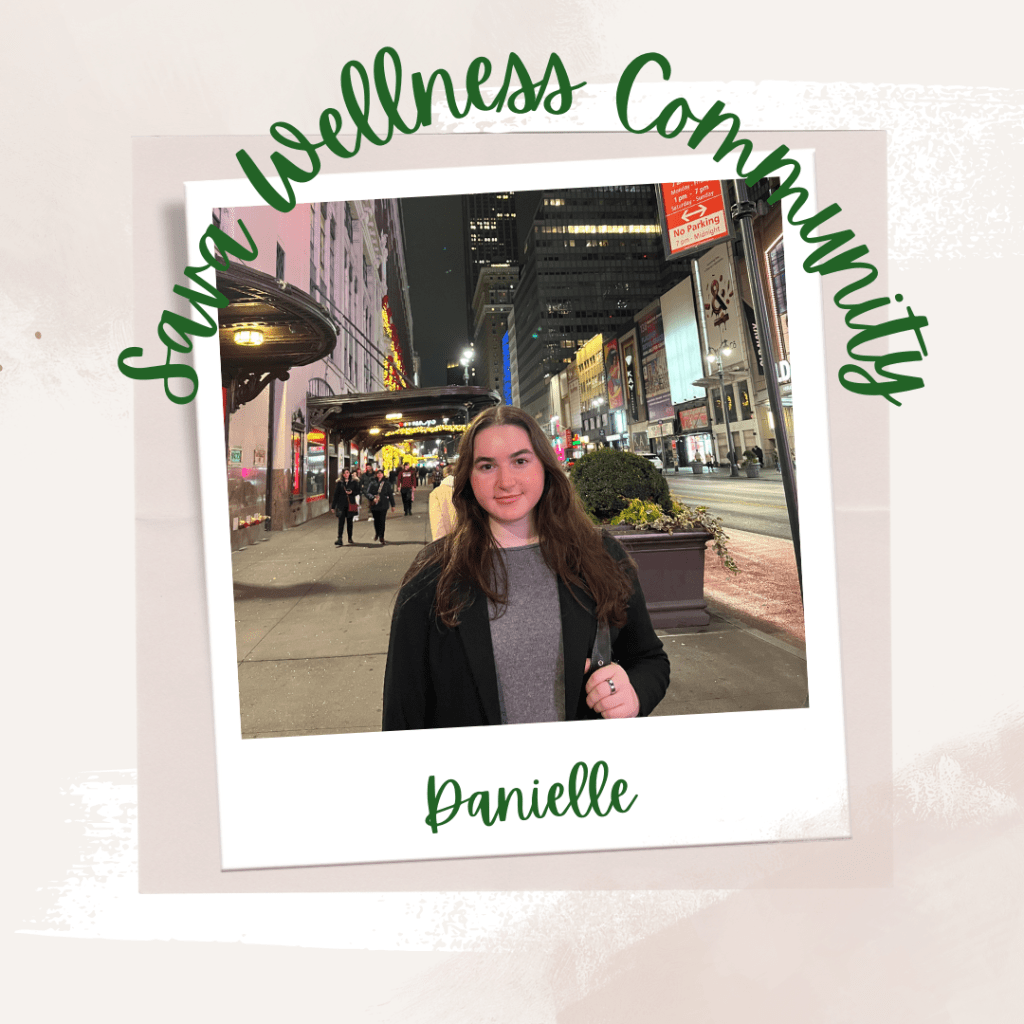
In this month’s interview we get to learn more about Danielle (she/her) and her three diagnoses. We also learn how she uses accommodations to continue to pursue her passions and what the word disabled means to her.
Hello Danielle! It is great to talk with you today. Could you please tell us a little about yourself?
Hi Sarah, thanks for having me! I’m from Seattle, Washington, and use she/her pronouns. I currently attend college in New York. I identify as chronically ill and disabled, but I find that term has so many meanings.
A lot of people assume disabled means ‘unable’, but that is far from the truth. I encounter people who don’t expect me to accomplish much once they learn about my diagnoses, but I am happy to prove otherwise. Disabled means ‘able with accommodations’ to me, it’s as simple as that. Some days I might need to take more breaks, or use mobility aids, but that doesn’t mean I am not capable of completing a task or taking on a challenge!
I currently work as a screenwriter. You can often find me on my laptop typing up my next story, or drawing in order to find my next inspiration. The arts are a huge part of my life, and they make it easier to process the challenges I am faced with due to my chronic illness. I can paint my struggles, write about my tribulations, and share my experiences with the world in hopes of connecting with other people who understand the challenges of being chronically ill. I enjoy my job a lot, as it can be fun to delve into different worlds–but I mostly enjoy using my stories to bring awareness to issues that don’t always have representation both on and off screen. My goal is to continue to bring these stories to life so those who live with these challenges feel more seen and heard–including myself.
Do you have a diagnosis for your symptoms?
I am diagnosed with Postural Orthostatic Tachycardia Syndrome (POTS), Mast Cell Activation Syndrome (MCAS), and Hypermobile Ehlers Danlos (hEDS). Basically, I have slow-flowing blood, overactive cells, and flimsy organs. Most importantly, my body doesn’t produce enough collagen to support the inner workings of all systems, so I get hurt really easily and my organs work twice as hard to function. This is caused by hEDS, something I was born with.
Many people with hEDS experience GI issues, which I didn’t even realize until it happened to me. I was having trouble swallowing things, and every time I ate something small I’d get nauseous. After a few tests, the doctors discovered my lower esophagus was made up of stomach lining. That meant my stomach was having so much trouble digesting that it was refusing the food, and needed more space to push it back up. I am currently waiting to hear if I have something called gastroparesis, known as a ‘sleeping’ or paralyzed stomach. It occurs when the stomach muscles are impaired and unable to properly react to food entering the area. Because hEDS causes weakened muscle tissue, it directly impacts vital organs like the stomach. It also goes to show that even when a diagnosis is finally found, doesn’t mean the problem is solved. A lot of chronic illnesses come with even more mysteries that branch out from one diagnosis to another.
hEDS triggers a plethora of other symptoms across my entire body when working in tandem with MCAS. I have a lot of trouble in hot climates as my cells expand too fast and cause light-headedness. But in the cold, my joints become stiff and I experience a lot of chronic pain. Not to mention the constant purple hands and feet! My normal body temperature rests around 96 degrees Fahrenheit [35.5 Celsius], which means I often have to layer up to keep myself warm. [Average body temperature is 37 degrees Celsius or 98.6 Fahrenheit].
With POTS, I can rely on those symptoms popping up whenever I do something seemingly simple like getting ready for the day. Standing too quick, raising my arms above my head, and bending down all cause episodes of presyncope–that black vision and jello-leg feeling yielding a warning for a fainting episode. My resting heart rate is around 115 bpm, which tricks my body into thinking it’s in fight or flight mode. [Average bpm is 60-100]. Whenever I stand, go for a walk, or complete housework, my heart rate usually sits at about 160 to 180 bpm. More episodes of presyncope can follow if I’m not careful, which is why it’s important to learn what accommodations my body needs in everyday life.
I received all of these diagnoses at age 18, only a year ago. I’ve had the symptoms of hEDS all my life, but the other two diagnoses I’ve only experienced fully for the past three years or so. At first, it was relieving to hear the cause of such extreme symptoms. I was left nearly passing out from climbing stairs, my heart racing every time I stood–it was all very scary and confusing. But then the diagnosis came with other issues, like the cursed words there’s no cure. Hearing I was stuck with these symptoms forever sounded so grim, but I wasn’t ready to accept that.
The doctors all told me I’d have to stop doing things I loved, like hiking, running, and jobs that required me to be on my feet. With my chronic joint pain, it even threatened my art. But I wasn’t ready to let that happen. It felt unfair to me that something out of my control could jeopardize my passions, but what was even more unfair was letting myself give up just because I felt overwhelmed with the news.
After a few months of learning how my chronic illnesses affected my every-day life, I was able to find a happy-medium for those things I enjoy. There were ways to change–or accommodate–those passions so I didn’t have to stop them entirely. I still hike, I just make sure to bring proper electrolytes and take breaks. I still work jobs that require me to be on my feet, I just communicate with my boss on what I need to be healthy and successful. And I of course still do art, if anything more than ever before. Just because I have the label ‘disabled’, does not make me any less able.
When did you first realize that you had chronic illness and how has your journey been since then?
I first realized that I had some sort of chronic issue when I experienced episodes of lethargy multiple times a week, often paired with fainting. It got to the point where I was in the hospital constantly, left with no answers and even more fear. I am lucky to have an amazing primary care provider that was willing to go on the journey with me to find out what was wrong. He listened to me, unlike a lot of doctors, and validated that what was happening wasn’t okay. Other doctors had told me it was just anxiety, or I just needed to drink more water. Turns out I just needed to get a different doctor.
How has your experiences of the world changed since your symptoms started?
I’ve always been aware of the term ‘disabled’ as someone with a learning disability, but I had never thought about needing mobility aids. It’s eye opening once you realize just how lacking accessibility is all over the world, and how much we have to advocate for ourselves wherever we go. If anything, it’s taught me how to be my own advocate. If I need an accommodation or accessibility change, I am confident in speaking up or requesting that. We live in a world where there are so many different needs, yet only so many are universally thought of.
What has been the most helpful for you as you have gone through this journey?
Harnessing my passions has been so important to me. On days when I feel like I can’t leave the house, I turn to my art to feel better. If I’m not up for creating an extremely detailed painting, I can simply doodle on a piece of paper. There’s so much flexibility in art; it’s always ready to meet me on the level I’m at.
Thank you Danielle!


![The words “Sava Wellness Community” are written in green cursive script over top of a polaroid picture. The polaroid picture is sitting on top of multiple layers of pink, cream, and white watercolour background. The polaroid picture has the name “Barbara” written in green under it. This is an artist representation of Barbara’s hypermobility that Barbara created herself. The subject is Barbara who has long red hair. She is holding her left arm which has her wrist extended. Barbara is sitting on the floor with her red shoes near her hips and she is wearing black.]](https://savawellness.ca/wp-content/uploads/2024/10/barbara-interview-october-2024.png?w=1024)



 Sava Wellness